Showing posts with label vedh shala. Show all posts

Wednesday, 26 November 2014

Sun Dial

Sun Dial


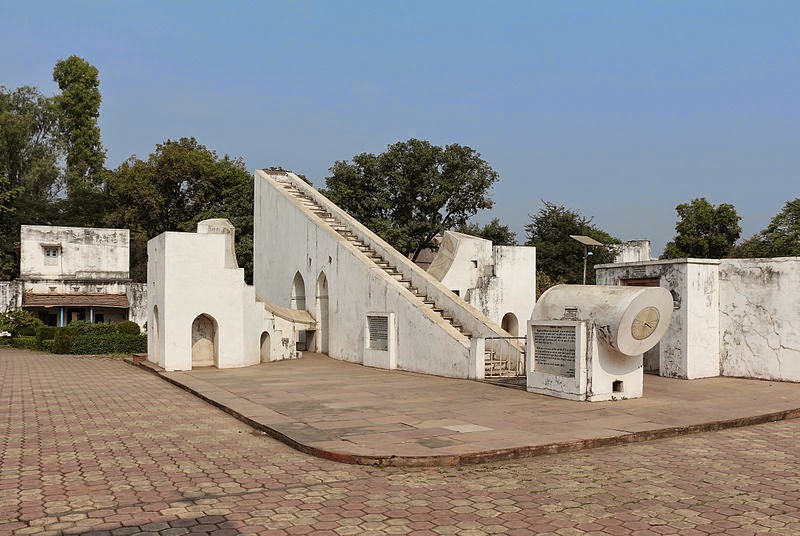
The upper planes of the two walls on the sides of the steps in the middle of this instrument are parallel to the axis of the earth. In the direction of the planes the pole star is visible. To the East and the West of the wall the quarter of a circle is formed in the plane of the Celestial equator on which hours, minutes and a third part of a minute are engaged.

When the Sun shines in the sky, the shadow of the edge of the wall falls on some mark indicating local time of Ujjain be calculating the hour and minutes. By adding minutes to this clear time table given on the east and the west side of the instrument, one knows the Indian Standard Time.
This Instrument is mainly used to find out the declination of any celestial body from the celestial equator towards the north or the south. First find out the particular point on the edge of the quadrant from where the centre of the celestial body could be observed to coincide with the edge of the wall. The reading at this point of the wall gives the declination.

Nadi Valve Yantra

Nadi Valve Yantra


This instrument made in the plane of the celestial equator has two – the north and the south parts. When the Sun is in the northern hemisphere for six months, the northern hemisphere disc is illuminated. But when the sun is in the southern hemisphere for the remaining six months, the southern disc is illuminated. The exact time of Ujjain is known by the shadow of the nails fixed parallel to the Earthâs axis in between these two parts.
This instrument is used to ascertain whether a celestial body is in the northern or the southern half. Observe a desired planet straight from a suitable point on the round edge of the northern part. If it is visible, then deem it to be in the northern hemisphere, otherwise it is in the southern one, likewise, information could be had from the southern part.

Tuesday, 25 November 2014

Shanku Yantra

Shanku Yantra


A vertical gnomon (Shanku) is fixed at the centre of the circular platform having a horizontal shape. The seven lines drawn according to the shadow of the gnomon indicate the twelve zodiac signs. Among these lines, the 22nd December makes the shortest day, the 21st March and the 23rd September make the days and nights equal, and the 22nd June makes the longest day of the year. With the help of the shadow of the gnomon the angle of elevation and zenith distance of the sun can determined. The Altitude of Ujjain is determined by the mid-day shadow of Shanku Ynatra when the days and nights have equal length.


Saturday, 22 November 2014

Jantar mantar

Jantar mantar


Vedh Shala, Ujjain is India's first observatory . The city of Ujjain is considered the Greenwich of India due to the fact that the first meridian of longitude passes through it. Going by the Indian astronomers, the Tropic of Cancer passes through Ujjain. This observatory was constructed by Savai Raja Jaysingh between 1725 and 1730. Similar observatories were constructed by Maharaja Jai Singh at four other places- Delhi, Jaipur, Mathura and Varanasi.

Samrat yantra, Nadivalaya yantra, Digamsha yantra and Yamyottara-Bhitti yantra are the main instruments constructed in this observatory. Motions and orbits of the planets are studied through these instruments. On the account of this people call it Yantra Mahal as well.This observatory was renovated by Madhav Rao Scindia, then Maharaja of Gwalior state in 1923. Astronomical studies of planetary motions are still conducted in this observatory under the department of education and an Ephemeris (Panchang) is published every year.

In other words, this is the only observatory among the observatories of Maharaja Jai Singh where these masonic instruments are even today utilised for astronomical studies.
Vedh Shala, Ujjain possesses instruments that are used to determine the locations of heavenly bodies for astrological purposes. The other things available in Vedh Shala in Ujjain in India are a small planetarium and a telescope for the purpose of moon-gazing and observing the planets Mars and Jupiter and their satellites. The Vedh Shala in Ujjain in India is a bit smaller than those in Jaipur and Delhi but is quite interesting and very much in use.
The structure of the monument reflects the hard word and superb skill that has gone into making it. Maharaja Jai Singh set up new instruments in these observatories employing his skills. He made alterations in a number of main Astro-mahematical instruments by observing the activities of planets himself for eight years in Ujjain. Thereafter the observatory remained uncared for two decades. Then as per suggestions of Siddhntavagish (Late) Shri Narayanji Vyas, Ganak Churamani and Shri G.S. Apte, the first Superintendent of observatory, Maharaja Madhav Rao Scindia renovated the observatory and funded it for active use.