Showing posts with label mahakal temple. Show all posts

Wednesday, 26 November 2014

Sun Dial

Sun Dial


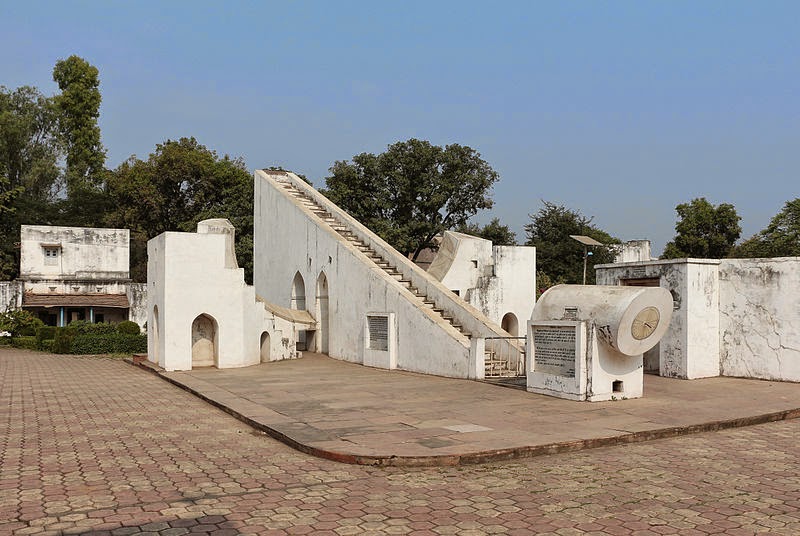
The upper planes of the two walls on the sides of the steps in the middle of this instrument are parallel to the axis of the earth. In the direction of the planes the pole star is visible. To the East and the West of the wall the quarter of a circle is formed in the plane of the Celestial equator on which hours, minutes and a third part of a minute are engaged.

When the Sun shines in the sky, the shadow of the edge of the wall falls on some mark indicating local time of Ujjain be calculating the hour and minutes. By adding minutes to this clear time table given on the east and the west side of the instrument, one knows the Indian Standard Time.
This Instrument is mainly used to find out the declination of any celestial body from the celestial equator towards the north or the south. First find out the particular point on the edge of the quadrant from where the centre of the celestial body could be observed to coincide with the edge of the wall. The reading at this point of the wall gives the declination.

Tuesday, 25 November 2014

Siddhavat Mandir

Siddhavat Mandir

 jai shree mahakal


As there is glory of the Ashayarat in Prayag, Boudhvat in Gaya and Vanshivat in Vrindavan and Panchavata of Nasik just like that Siddhvat is a famous place of pilgrimage in Ujjain. According to tradition, all these trees are immortals & worshipped as Kalpniksha. According to Aramkand of Skandpurana, this tree was planted by Goddess Parvati herself. In diety devil war, the demons emperor Tarkasu was killed by Swami Kartikeya, the son of Lord Shiva. Kartik Swami was appointed as army leader by diety. Under this tree the power by which Swami Kartikeya killed Tarkasu is situated in the middle of Shipra and is known as Shaktibeah Tirth. Thousands of pilgrims take a dip in the Shipra from the bathing ghat built here.

Goddess Parvati made food eaten by Swami Karthikeya. According to history Raja Vikramaditya got Betal Siddhi after doing austerity here. Mahendra, Sangamitra the son & daughter of Raja Ashok after worshipping here traveled long distances – to countries such as Sri Lanka. In the Mughal times, destruction took place in Ujjain like other places in India. At the same time, this tree was cut & closed by 7 round plates but immediately after a great blitz it got free again. It is the characteristic of this pilgrimage that is related with property, children and salvation. 3 main characteristics are-

For the fulfillment of desires the thread (Raksha Sutra) is tied here.
For the desire of child especially an opposite Swastik is made here afterwards the lap is filled by coconut.
For the peace of forefathers (milk is poured to its branches). There is a special importance of Pind Dan here.

The little village of Bhairogarh near Siddhavat was known for dye painting for centuries. In ancient times when trade with other countries flourished, cloth from Bhairogarh found its way to Rome & China.

Insights: I skipped this mandir and we drove towards Mangalnath mandir but wifey Aparna insisted that we return to the place, a wise decision. I was greatly enamored by this open-air temple on the banks of the river Shipra. Something special about the place. To the right of the temple is the Tree where devotees tie red thread. People come from far and wide. We met an old couple from Churu Rajasthan.

Shanku Yantra

Shanku Yantra


A vertical gnomon (Shanku) is fixed at the centre of the circular platform having a horizontal shape. The seven lines drawn according to the shadow of the gnomon indicate the twelve zodiac signs. Among these lines, the 22nd December makes the shortest day, the 21st March and the 23rd September make the days and nights equal, and the 22nd June makes the longest day of the year. With the help of the shadow of the gnomon the angle of elevation and zenith distance of the sun can determined. The Altitude of Ujjain is determined by the mid-day shadow of Shanku Ynatra when the days and nights have equal length.


Kalidasa Academy

Kalidasa Academy .part 1

 jai shree mahakal


This academy was set up in Ujjain by the Government of Madhya Pradesh to immortalize the memory of the great poet dramatist-Kalidasa, and to create a multi-disciplinary institution to project the genius of the entire classical tradition, with Kalidasa as the apex, enable research and study in Sanskrit classical and traditional performing arts, and facilitate its adaptation for contemporary stage in different cultural settings and language groups. The Academy complex consists of a theatre, museum, library, lecture and seminary halls, mini stage for rehearsals, research facilities for scholars, and a large open-air theater.

Quote HCI, “Kalidasa is by common consent the greatest and poet and dramatist that ever in India. Yet curiously enough, we know hardly anything about his life and have no definite knowledge of the time when he flourished. He is said to be one of the nine learned men who graced the court of king Vikramaditya. Most scholars regarded as a historical fact his association with king Vikramaditya of Ujjain, and the deliberate change in the name of the hero of the Vikramorvasiyam from Pururavas to Vikrama lends color to it. Some regard this Vikramaditya as the ruler, who according to well established tradition defeated the Sakas in 58 B.C. and found an era – the well-known Vikrama samvat to commemorate this fact. There are many views on when he existed. The safest course is to hold that Kalidasa

flourished some time between 100 B.C. and 450 A.D.


Monday, 24 November 2014

Vikram Kirti Mandir

Vikram Kirti Mandir


Established on the occasion of the second millennium of the Vikram era, as the cultural centre to perpetuate the memory of Vikramaditya, the Vikram Kirti Mandir houses the Scindia Oriental Research Institute, an archaeological museum, an art gallery and an auditorium. The Scindia Oriental Research Institute has an invaluable collection of 18,000 manuscripts on various subjects and runs a reference library of important oriental publications. Rare manuscripts in Prakrit, Arabic, Persian and other Indian languages cover a wide range of subjects from Vedic literature and philosophy to dance and music. Palm leaf and bark leaf (Bhurja Patra) manuscripts are also preserved in this institute. Apart from an illustrated manuscript of Shrimad Bhagavata in which actual gold and silver have been employed for the paintings, the Institute has a rich collection of old paintings in the Rajput and Mughal style. The museum also exhibits a rich array of images, inscriptions, copper plates and fossils discovered in the Narmada valley. A huge skull of a primitive elephant is of special interest. Unfortunately the Mandir was closed for Christmas holiday when we went there.

Vikrama Samvat

Vikrama Samvat

 jai shree mahakal


Unlike the Christian calendar which is based on the birth of Jesus the Vikram Samvat calendar is based on the year from which King Vikramaditya established peace & prosperity over Malwa. HCI have dedicated five pages to Samvat in volume 2. According to HCI, “The era might after all have been founded by a foreigner as stated above. But there is no inherent congruity in the belief that king Vikramaditya founded it in 59 B.C. to commemorate his recovery of Ujjayini by defeating the Sakas”.

Insights: Besides the Vikram University the only icon of Vikramaditya in Ujjain was in a bye lane close to Harsiddhi mandir. The sad part is that there is for the common man not enough information about Vikramditya & Kalidasa

both of whom are synonymous with Ujjain in a historic sense. I tried hard but did not find any City sign boards that spoke about them.

Sunday, 23 November 2014

Chintamani Ganesh Mandir

Chintamani Ganesh Mandir

 jai shree mahakal


The present sanctum of Chintamani Ganesh is very old. The Ganesh icon is swayambhu – born of itself. Riddhi & Siddhi, the two goddesses are enshrined on both sides of the icon of Ganesh. Traditionally, this is known as the seat of Chintaharan Ganesh (assurer of freedom from worldly anxieties). People assemble here in large numbers to offer their prayers on Wednesdays in the month of Chaitra. Artistic pillars in the assembly hall of the temple belong to the Parmar period (9-12th century). The temple was renovated by Ahilyabhai Holkar with the addition of a water tank and boundary wall. It is said that while returning to Ayodhya after victory over Ravana, Lord Ram rested here. To get rid of thirst, Lakshman dug out the water with his arrow. This is the reason the water tank is called Banganga.


 jai shree mahakal


Saturday, 22 November 2014

Jantar mantar

Jantar mantar


Vedh Shala, Ujjain is India's first observatory . The city of Ujjain is considered the Greenwich of India due to the fact that the first meridian of longitude passes through it. Going by the Indian astronomers, the Tropic of Cancer passes through Ujjain. This observatory was constructed by Savai Raja Jaysingh between 1725 and 1730. Similar observatories were constructed by Maharaja Jai Singh at four other places- Delhi, Jaipur, Mathura and Varanasi.

Samrat yantra, Nadivalaya yantra, Digamsha yantra and Yamyottara-Bhitti yantra are the main instruments constructed in this observatory. Motions and orbits of the planets are studied through these instruments. On the account of this people call it Yantra Mahal as well.This observatory was renovated by Madhav Rao Scindia, then Maharaja of Gwalior state in 1923. Astronomical studies of planetary motions are still conducted in this observatory under the department of education and an Ephemeris (Panchang) is published every year.

In other words, this is the only observatory among the observatories of Maharaja Jai Singh where these masonic instruments are even today utilised for astronomical studies.
Vedh Shala, Ujjain possesses instruments that are used to determine the locations of heavenly bodies for astrological purposes. The other things available in Vedh Shala in Ujjain in India are a small planetarium and a telescope for the purpose of moon-gazing and observing the planets Mars and Jupiter and their satellites. The Vedh Shala in Ujjain in India is a bit smaller than those in Jaipur and Delhi but is quite interesting and very much in use.
The structure of the monument reflects the hard word and superb skill that has gone into making it. Maharaja Jai Singh set up new instruments in these observatories employing his skills. He made alterations in a number of main Astro-mahematical instruments by observing the activities of planets himself for eight years in Ujjain. Thereafter the observatory remained uncared for two decades. Then as per suggestions of Siddhntavagish (Late) Shri Narayanji Vyas, Ganak Churamani and Shri G.S. Apte, the first Superintendent of observatory, Maharaja Madhav Rao Scindia renovated the observatory and funded it for active use.

Thursday, 20 November 2014

Simhastha

Simhastha


It finds mention in the Hindu mythological tale of churning of the cosmic ocean by the gods and the demons, with Vasuki, the serpent as the rope. It is believed that the ocean bed first yielded fourteen gems, then Lakshmi, the goddess of wealth, and finally the coveted vessel of Nectar.
In the wild scramble for immortality, with the demons chasing the Gods across the skies, a few drops of the Nectar spilt from the vessel and fell at Haridwar, Nasik, Prayag, and Ujjaini or the present Ujjain. Therefore, the Kumbha Parva is celebrated at the interval of every twelve years at these places.


The specific features of Kumbha alias Simhastha in Ujjain is its association with Leo, thus being famous as the Simhastha Parva. On this occasion the following ten coincidences assemble together
  • The month of Baisakha
  • The bright fortnight
  • The full Moon day (Purnima)
  • The Sun in the arise (Mesha Rasi)
  • The Brihaspati (Jupiter) in Leo
  • The Moon in the Libra (Tula rasi)
  • The vyatipata yoga
  • The pious Monday
  • The holy Ksetra Avantika

On the occasion of this pious Parva lakhs of pilgrims from India and abroad take bath here and exhibit their religious faith. The most peculiar feature is the procession of the seers and sages moving towards the Sipra for the holy dip. These religious leaders stay in Ujjain during the whole Simhastha period and take bath on specific bath-days with freat faith and enthusiasm with their sectorial banners (Nisanas).
During the Simhastha Parva every pilgrim after taking the bath visits the temple and humbly bows down before the Lord. The sight of the temple is very enchanting and rarely seen on that occasion. The law and order situations are well-planned and very alert then. The whole atmosphere echoes with the Jaya Jayakara (Victory to the Lord) Mahakalesvara.

Saturday, 15 November 2014

simhastha mela

सिंहस्थ मेला

उज्जैन का सिंहस्थ मेला बहुत ही दुर्लभ संयोग लेकर आता है इसलिए इसका महत्व और भी अधिक बढ़ जाता है। इस दिन यहाँ दस दुर्लभ योग होते हैं, जैसे : वैशाख माह, मेष राशि पर सूर्य, सिंह पर बृहस्पति, स्वाति नक्षत्र, शुक्ल पक्ष, पूर्णिमा आदि। 


प्रति बारह वर्ष में पड़ने वाला कुंभ मेला यहाँ का सबसे बड़ा मेला है, जिसमें देश-विदेश से आए साधु-संतों व श्रद्धालुओं का जमावड़ा लगता है। महाकालेश्वर मंदिर के ऊपरी तल पर स्थित प्राचीन व चमत्कारी नागचंद्रेश्वर मंदिर वर्ष में एक बार केवल नागपंचमी को ही श्रद्धालुओं के दर्शनार्थ खोला जाता है। यहाँ हर वर्ष श्रावण मास में भगवान महाकाल की शाही सवारी निकाली जाती हैं। 
हर सोमवती अमावस्या पर उज्जैन में श्रद्धालु पुण्य सलिला शिप्रा स्नान के लिए पधारते हैं। फाल्गुनकृष्ण पक्ष की पंचमी से लेकर महाशिवरात्रि तक तथा नवरात्रि महोत्सव पर यहाँ महाकालेश्वर ज्योतिर्लिंग के विशेष दर्शन, पूजन व रूद्राभिषेक होता है।


सिंहस्थ मेले के बारे में यह कहा जाता है कि जब समुद्र मंथन के पश्चात देवता अमृत कलश को दानवों से बचाने के लिए वहाँ से पलायन कर रहे थे, तब उनके हाथों में पकड़े अमृत कलश से अमृत की बूँद धरती पर जहाँ-जहाँ भी गिरी थी, वो स्थान पवित्र तीर्थ बन गए। उन्हीं स्थानों में से एक उज्जैन है। यहाँ प्रति बारह वर्ष में सिंहस्थ मेला आयोजित होता है। 


उज्जैन का सिंहस्थ मेला बहुत ही दुर्लभ संयोग लेकर आता है इसलिए इसका महत्व और भी अधिक बढ़ जाता है। इस दिन यहाँ दस दुर्लभ योग होते हैं, जैसे : वैशाख माह, मेष राशि पर सूर्य, सिंह पर बृहस्पति, स्वाति नक्षत्र, शुक्ल पक्ष, पूर्णिमा आदि। 


jai shree mahakal

jai shree mahakal
महाकालेश्वर मंदिर 


महाकालेश्वर मंदिर एक विशाल परिसर में स्थित है, जहाँ कई देवी-देवताओं के छोटे-बड़े मंदिर हैं। मंदिर में प्रवेश करने के लिए मुख्य द्वार से गर्भगृह तक की दूरी तय करनी पड़ती है। इस मार्ग में कई सारे पक्के चढ़ाव उतरने पड़ते हैं परंतु चौड़ा मार्ग होने से यात्रियों को दर्शनार्थियों को अधिक ‍परेशानियाँ नहीं आती है। गर्भगृह में प्रवेश करने के लिए पक्की सीढ़ियाँ बनी हैं।


मंदिर परिसर में एक प्राचीन कुंड है। वर्तमान में जो महाकालेश्वर ज्योतिर्लिंग है वह तीन खंडों में विभाजित है। निचले खंड में महाकालेश्वर, मध्य के खंड में ओंकारेश्वर तथा ऊपरी खंड में श्री नागचंद्रेश्वर मंदिर स्थित है। गर्भगृह में विराजित भगवान महाकालेश्वर का विशाल दक्षिणमुखी शिवलिंग है, ज्योतिष में जिसका विशेष महत्व है। 


इसी के साथ ही गर्भगृह में माता पार्वती, भगवान गणेश व कार्तिकेय की मोहक प्रतिमाएँ हैं। गर्भगृह में नंदी दीप स्थापित है, जो सदैव प्रज्ज्वलित होता रहता है। गर्भगृह के सामने विशाल कक्ष में नंदी की प्रतिमा विराजित है। इस कक्ष में बैठकर हजारों श्रद्धालु शिव आराधना का पुण्य लाभ लेते हैं। 


उज्जैन का इतिहास

jai shree mahakal

उज्जैन का इतिहास

उज्जैन की प्रसिद्धि सदियों से एक पवित्र व धार्मिक नगर के रूप में रही है। लंबे समय तक यहाँ न्याय के राजा महाराजा विक्रमादित्य का शासन रहा। महाकवि कालिदास, बाणभट्ट आदि की कर्मस्थली भी यही नगर रहा। श्रीकृष्ण की शिक्षा भी यहीं हुई थी। 


दैवज्ञ वराहमिहिर की जन्मभूमि, महर्षि सांदीपनि की तपोभूमि, भर्तृहरि की योगस्थली, हरीशचंद्र की मोक्षभूमि आदि के रूप में उज्जैन की प्रसिद्धि रही है। उज्जैन का वर्णन कई ग्रंथों व पुराणों जैसे शिव महापुराण, स्कंदपुराण आदि में हुआ है। 


jai shree mahakal

jai shree mahakal


आकाशे तारकं लिंगं पाताले हाटकेश्वरम् ।


भूलोके च महाकालो लिंड्गत्रय नमोस्तु ते ॥

आकाश में तारक लिंग, पाताल में हाटकेश्वर लिंग तथा पृथ्वी पर महाकालेश्वर ही मान्य शिवलिंग है। 


भारत के हृदयस्थल मध्यप्रदेश के उज्जैन में पुण्य सलिला शिप्रा के तट के निकट भगवान शिव 'महाकालेश्वर ज्योतिर्लिंग' के रूप में विराजमान हैं। महाराजा विक्रमादित्य के न्याय की नगरी उज्जयिनी में भगवान महाकाल की असीम कृपा है। देशभर के बारह ज्योतिर्लिंगों में 'महाकालेश्वर ज्योतिर्लिंग' का अपना एक अलग महत्व है। कहा जाता है कि जो महाकाल का भक्त है उसका काल भी कुछ नहीं बिगाड़ सकता। महाकाल के बारे में तो यह भी कहा जाता है कि यह पृथ्वी का एक मात्र मान्य शिवलिंग है। महाकाल की महिमा का वर्णन इस प्रकार से भी किया गया है

उज्जैन का सिंहस्थ मेला बहुत ही दुर्लभ संयोग लेकर आता है इसलिए इसका महत्व और भी अधिक बढ़ जाता है। इस दिन यहाँ दस दुर्लभ योग होते हैं, जैसे : वैशाख माह, मेष राशि पर सूर्य, सिंह पर बृहस्पति, स्वाति नक्षत्र, शुक्ल पक्ष, पूर्णिमा आदि।


Friday, 14 November 2014

Ujjain district

Ujjain district


Ujjain District is a district of Madhya Pradesh state in central India. The historic city of Ujjain is the district headquarters.
The district has an area of 6,091 km², and a population of 1,709,885 (2001 census), a 24% increase from its 1991 population of 1,386,465. The district is bounded by the districts of Shajapur on the northeast and east, Dewas to the southeast, Indore to the south, Dhar to the southwest, and Ratlam to the west and northwest. The district is part of Ujjain Division

According to the 2011 census Ujjain District has a population of 1,986,597,roughly equal to the nation of Slovenia or the US state of New Mexico. This gives it a ranking of 233rd in India (out of a total of 640) The district has a population density of 326 inhabitants per square kilometre (840 /sq mi) . Its population growth rate over the decade 2001-2011 was 16.11%. Ujjain has a sex ratio of 954 females for every 1000 males, and a literacy rate of 73.55%.

Wednesday, 12 November 2014

ujjain history. part 6

ujjain history. part 6


A fragmented inscription of this place records the building of the palace in 1458, in the time of Mahmud Khilji. The story goes that the tanks were constructed all around to keep the temperature very low by Sultan Nasiruddin Khilji, the Sultan of Malwa in the 16th century, because he was in the habit of taking mercury which is hot.
As a great religious centre, Ujjain ranks equalto Benaras, Gaya and Kanchi.
Saivism, Vaishnavism and their various cults and sects, Jainism and Buddhism, have found a niche in this ancient city. The Avanti Khanda of the Skanda Purana mentions innumerable temples consecrated to Shakti and her various forms. The Siddha and the Natha cults which were offshoots of Tantricism, also flourished in Ujjain.
One of the 12 Jyotirlingas in India, the lingam at the Mahakal see www.mahakaleshwar.nic.in is believed to be swayambhu (born of itself) deriving currents of power (shakti) from within itself as against the other images and lingams which are ritually established and invested with mantra-shakti.
The idol of Mahakaleshwar is known to be Dakshinamurti, facing the south. This is a unique feature upheld by tantric traditions to be found only in Mahakaleshwar among the 12 Jyotirlingas. The idol of Omkareshwar Shiva is consecrated in the sanctum above the Mahakal shrine. The images of Ganesh, Parvati and Karttikeya are installed in the west, north and east of the sanctum sanctorum. To the south is the image of Nandi. The idol of Nagchandreshwar on the third storey is open for darshan only on the day of Nag Panchami. On the day of Mahashivaratri, a huge fair is held near the temple and worship goes on through the night.


ujjain history. part 5

ujjain history. part 5


The names of Kalidasa and Ujjayini are inextricably linked together in the Indian traditions. It is in Meghdoot, a poem of a little over hundred verses, describing the anguish of ayaksha, separated from his beloved by a curse, sending a message to her in the city of Alaka through a rain cloud from his exile in Ramagiri (now identified as Ramtek near Nagpur) that Kalidasa's love of Ujjayini finds full expression.
The poet describes the imaginary passage of the cloud over Ujjayini, and it is almost as if he is loath to move on, for in 12 verses (27-38), there is a lyrical description of the city and the people which conjures up a vivid picture of a civilized attractive society, a leisured class, intensely practical and yet imbued with deeply religious and philosophical preoccupations. See a visualisation based on one of these verses by artist Nana Joshi here.
Aurangzeb gave numerous grants to temples belying tales of intense religious bigotry, which are preserved to this day by the families of the priests.He is said to have issued a firman giving blanket protection to Dara Shikoh's guru, Kavindracharya Saraswati, after he killed his brother. Several manuscripts signed by Kavindracharya Saraswati are preserved in the Scindia Oriental Institute to this day.
It is believed that there was once a majestic Sun temple at this site. The Avanti-Mahatmya of the Skanda Purana has recorded a description of the Sun Temple and two tanks, the Surya Kunda and the Brahma Kunda. People from nearby villages have a ritual dip in the Surya Kunda even today. Remains of the old temple are found scattered all over this area.

ujjain history. part 4

ujjain history. part 4


At the beginning of the 17th century, Ujjain and Malwa went through another period of seizure and invasion at the hands of the Marathas, who gradually captured the entire region. The Maratha domination of Malwa gave impetus to a cultural renaissance in the region and modern Ujjain came into being. Most of the temples of Ujjain were constructed during this period.
It was during this time that Ujjain became the meeting ground of painters of the Poona and Kangra styles. The impact of the two different styles of painting is distinctive. The examples of Maratha style are found in the temples of Ram Janardan, Kal Bhairava, Kalpeshwar and Tilakeshwar while the traditional Malwa style can be seen in the Sandipani Ashram and in many large houses of the local seths.
In the Maratha period, the art of wood work also developed. Wood carvings were done on the galleries and balconies. But many excellent examples have either been sold as junk or destroyed. Ujjain finally passed into the hands of the Scindias in 1750 and until 1810, when Daulat Rao Scindia founded his new capital at Gwalior, it was the chief town of his dominions. The shifting of the capital to Gwalior led to a decline in the commercial importance of Ujjain.
But the opening of Ujjain-Ratlam-Godhra branch of the Bombay-Baroda line corrected the balance. A considerable volume of trade mainly with Bombay, existed in cotton, grain and opium during the British Indian period.
There is much to demonstrate that in the perspective of India's long history, Ujjain enjoyed great importance in the battle for the empire and the constant struggle for supremacy. Political importance was compounded by the economic factor of Ujjain being situated on the main artery of trade between the North, the South and the West. This in turn contributed to Ujjain acquiring a cultural splendour of its own which is equaled by very few other cities in India.

ujjain history. part 3

ujjain history. part 3


Malwa was lost in the time of Vakpati's successor, Vairisimha II, to the invading forces of Mahipala I who avenged his defeat at the hands of Indra III by invading the empire of Rastrakuta. Mahipala and his Kalachuri confederate Bhamanadeva are said to have conquered the territory up to the banks of the Narmada including Ujjain and Dhar. The Paramara sovereignty in the Malwa ceased around AD 946 when Vairsimha II became dominant in the area.
It is in his son Siyaka II's reign that the independent Paramara rule in Malwa began. It is believed that it was this time that the capital was shifted to the area of the Mahakala Vana in Ujjain. From the 9th to the 12th centuries, the Paramaras became so identified with Ujjain that subsequent tradition has converted Vikramaditya into a Paramara. The last Paramara ruler, Siladitya, was captured alive by the Sultans of Mandu, and Ujjain passed into the hands of the Muslims.
Thus began a long era of misfortune and decay and the ancient glory of Ujjayini was lost in a morass of repeated inroads of attacking hordes. The invasion of Ujjain by Iltutmish in 1234 triggered off a systematic desecration and despoiling of temples. This tide of destruction was stemmed only in the time of Baz Bahadur of Mandu. The Mughal rule heralded a new era in reconstruction. Emperor Akbar put an end to Baz Bahadur's hegemony over Malwa and had a city wall constructed for the defense of Ujjain.
The Nadi Darwaza, Kaliadeh Darwaza, Sati Darwaza, Dewas Darwaza and Indore Darwaza were the various entrances to the city. In 1658 took place a battle near Ujjain in which Aurangzeb and Murad defeated Maharaja Jaswant Singh of Jodhpur, who was fighting on behalf of Prince Dara. The actual scene of the battle is Dharmatpura renamed Fatehbad by Aurangzeb, after the victory.
The cenotaph of Raja Rattan Singh of Ratlam, who fell in the battle, still stands at the site. In the reign of Mahmud Shah, Maharaja Sawai Jai Singh was made the Governor of Malwa. A great scholar of astronomy, he had the observatory at Ujjain reconstructed and built several temples.

ujjain history. part 2

ujjain history. part 2


The early history of Ujjain goes back to the period of Iron Age India. By the 6th century BC, the large kingdom of Avanti, with its capital at Ujjaini, is mentioned in Buddhist literature as one of the four great powers along with Vatsa, Kosala and Magadha. Ujjain lay on the main trade route between North India and Deccan going from Mathura via Ujjain to Mahismati (Maheshwar) on the Narmada, and onto Paithan on the Godavari, western Asia and the West. The Northern black polished ware - the NBP as it is often called which is technically the finest pottery of the time, with a brilliantly burnished dressing almost of the quality of a glaze in colour from jet black to a deep grey or metallic blue and iron, found their way to the northern Deccan from the Gangetic plains through Ujjain.
The articles of export to the western Asia such as precious stones and pearls, scents and spices, perfumes, silks and muslin, reached the port of Brighukachcha from the remote north through Ujjain. All this finds a detailed and interesting description in the Periplus of the Erythrean Sea, an account of an unknown Greek merchant who made a voyage to India in the second half of the 1st century AD. The Periplus talks of a city called Ozene to the east of Barygaza (Broach) which fed all commodities to trade like onyx, porcelain,fine muslin and quantities of ordinary cotton, spikenard, costus bodellium to this important port and to other parts of India.
The earliest known epigraphic record of the Paramaras, the Harsola Granth, issued at the beginning of the 10th century, maintains that the kings of the Paramara dynasty were born in the family of the Rastrakutas in the Deccan. The early Paramara chiefs of Malwa were probably vassals of the Rastrakutas. The Udaypur Prasati, mentions Vakpati Vakpati I as the king of Avanti and it was probably in his region that the Rastrakuta Indra III halted at Ujjain while advancing with his army against the Pratihara Mahipala I.

ujjain history. Part1

ujjain history. Part 1


In Indian mythology, the origin of the city is ascribed to the act of Sagar Manthan, which refers to the churning of the primordial ocean performed by the demigods and demons to discover a pot containing the nectar of immortality. The story goes that after the nectar was discovered, a fierce struggle ensued between the demigods and the demons to obtain the nectar for the attainment of immortality. During the chase, a drop of nectar spilled and fell on Ujjain, thus making the city sacred. According to legend, the river Kshipra that flows across Ujjain is regarded to have originated owing to the churning of the gods and goddesses.
Apart from the rich tapestry of myths and legends surrounding the city, Ujjain has stood witness to a long and distinguished history: it was home to legendary rulers including the renowned king Chandragupta II, great scholars such as Brahmagupta and Bhaskaracharya, and literary gems like Kalidasa. Since the 4th century BC, the city was considered the prime meridian by Hindu astrologers, and it was placed as the centre of the world in numerous ancient world maps. In the past, Ujjain was variously known as Arin, Aryn or Ozein to the outside world.