Showing posts with label tourism. Show all posts

Wednesday, 26 November 2014

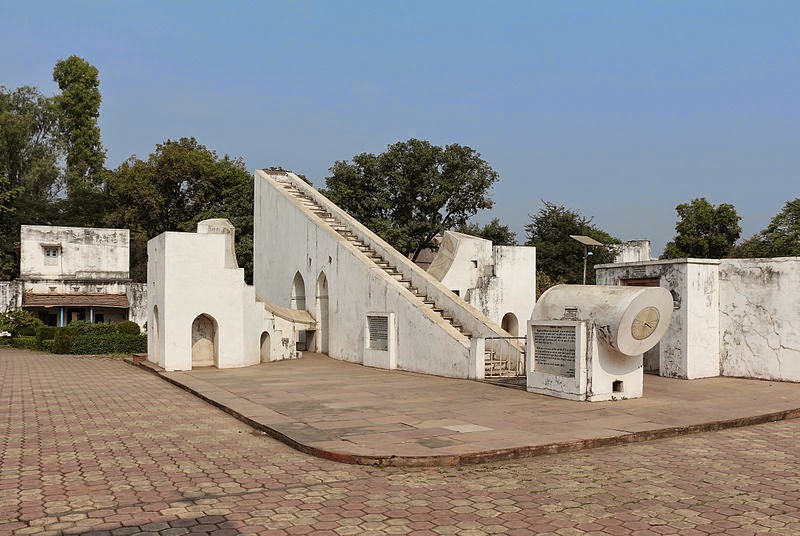
Nadi Valve Yantra

Nadi Valve Yantra


This instrument made in the plane of the celestial equator has two – the north and the south parts. When the Sun is in the northern hemisphere for six months, the northern hemisphere disc is illuminated. But when the sun is in the southern hemisphere for the remaining six months, the southern disc is illuminated. The exact time of Ujjain is known by the shadow of the nails fixed parallel to the Earthâs axis in between these two parts.
This instrument is used to ascertain whether a celestial body is in the northern or the southern half. Observe a desired planet straight from a suitable point on the round edge of the northern part. If it is visible, then deem it to be in the northern hemisphere, otherwise it is in the southern one, likewise, information could be had from the southern part.

Tuesday, 25 November 2014

Gadhkalika Mandir

Gadhkalika Mandir


 jai shree mahakal


Shri Gadhkalika mandir is traditionally known to be the choice of worship of the greatest poet Kalidasa – the author of Abigyna Shakuntala and chief gem of the court of Raja Vikramaditya. Images and bricks & part of the plinth are of the 1st century B.C. (Shunga period), 4th century A.D. (Gupta period) and 10th century A.D. (Parmar period) were recovered from the basement of the temple. Emperor Harshvardhan got this temple renovated in the 7th century a.d. – there is some indication of its further renovation in the 10th century a.d. under Parma rule. In the 20th century, the traditional priest Shri Siddhanath Maharaj got this temple renovated in Samvat 2001 (1944 A.D.). The temple has been rebuilt in modern times by the erstwhile Gwalior state. A beautiful sculpture of Yakshini belonging to the 4-5th century a.d. was recovered from this place, which is presently displayed at Bharati Kala Bhavan Museum, Ujjain.

Sunday, 23 November 2014

Chardham Mandir

Chardham Mandir


Founded by Shanti Swarupanandji Maharaj. Since a number of us are unable to do the chardham for a variety of reasons Maharajji made four temples in Ujjain itself so that devotees can take anand (joy) there itself. The char dhams are Jagannath dham (East, Orissa), Dwarkadhish dham (West, Gujarat), Badrinath dham (North, Uttranchal) and Rameshwar dham (South, Tamil Nadu).

Sandipani Ashram

Sandipani Ashram

 jai shree mahakal


The fact that ancient Ujjain apart from its political and religious importance, enjoyed the reputation of being a great seat of learning as early as the Mahabharata period is borne out by the fact that, Lord Krishna and Sudama received regular instruction in the ashram of Guru Sandipani. The area near the ashram is known as Ankapata, popularly believed to have been the place used by Lord Krishna for washing his writing tablet. The numerals 1 to 100 found on a stone are believed to have been engraved by Guru Sandipani.

According to Puranic tradition Krishna & his friend Sudama received regular instructions in the Ashram of Kulaguru Sandipani. Besides Mahabharata, the Puranas, Shrimad Bhagavata, Brahma, Agni & Brahmavairaita bear references to the Sandipani Ashram. Archaeological evidence of 3,000 years old painted grey wares has been recovered from this area. These bear a resemblance to the similar remains recovered at Hastinapura, Indraprastha, Mathura & Kausambi. These evidences show that this region is the oldest in the city. Gomati Kund is the old source of water supply to the Ashram & the same has been referred to in the Puranas also.

The image of standing Nandi near the tank is worth seeing and it belongs to the Shunga period. We were told that it is the only temple in India where Nandi is standing as elsewhere Nandi is found sitting. The area nearby is known as Ankapata.

In all Shiv temples the Nag (snake) is invariably wound around the Lingam. In this ashram there is a Shiv temple in which there is a lingam with the Nag crawling by its side.

In the beginning of the 16th century the great Vaishnava saint Shri Vallabhacharya delivered his religious discourses in the vicinity of this ashram. The followers of the Vallabha sect count this place as the 73rd seat of their acharya who is said to have made 84 sittings for religious discourses throughout through out India. We were taken around by Harsh Vyas who belongs to Sandipani Rishi ka vansh.

Insights: Mitras something special about this place, the positive vibrations and feeling of equanimity that we experienced.

Mangalnath Mandir

Mangalnath Mandir


 jai shree mahakal


According to Matsya puran, this is the birthplace of Mangalgraha or Mars. Flowing Shipra river presents a very beautiful view in front of the temple. Devotees gather in large numbers esp. on Tuesday. Located on a hillock, this place represents the highest place in the area. In ancient times, the place was famous as it is said to have provided a clear view of Mars – Ujjain was an important center for astronomical studies. This place, traditionally known for its suitability for astronomical readings of mars continues to hold its religious importance. Worship of Lord Shiva is offered at the temple. Karkarekha goes through the center of the Shivalinga at Mangalnath, it is centrally placed.

Insights: This is the only authentic temple in the country for the puja of the Mangal graha which is Mars. As a planet Mars is supposed to make a person very aggressive which could have adverse effects overall if the energy is not channelised in the right manner. For those who have mangaldosh a special puja is performed only at this temple in the country. We witnessed one such Shanti Puja in which the lingam was smeared with kumkum, panchaamrut and later on with cooked rice. Finally the Pandit completed the puja with Shringar of the lingam. We were fortunate to witness the entire process. Even though it was someone else’s puja he explained the entire process to us and got us to experience it firsthand.

Kaal Bhairav

Kaal Bhairav


 jai shree mahakal


Shaivite form of worship has also assigned importance to the adoration of 8 Bhairavas. Kaal Bhairav is the foremost amongst them. Skanda purana has made a mention of the temple of Kaalbhairav in its Avanti Khanda. According to some antique tradition, the followers of Kapalika & Aghora sects used to worship Shiva or Bhairava. Ujjain was also connected with the pattern of worship developed by these sects. People offer liquor as part of the worship. It is said that a certain king named Bhadrasen got this temple constructed; this must have been a great temple during the Parmar period. Images of Shiva, Parvati, Vishnu & Ganesh have been recovered from this place. This temple was rebuilt with the remains of the old temple. Beautiful paintings in Malwa style once decorated the temple walls. The temple to the right of the courtyard is dedicated to Vithala and to the left is a Dharamshala.

Insights: Seeing devotees offer liquor to God can be scary for some not for those who come with bhavna & respect for the Lord. The mandir is situated on what was once a cremation ground. A new cremation ground is situated close to the mandir. The temple Pandit looked a bit different, wifey found him scary but I found him very intuitive.

Shani Mandir

Shani Mandir


Triveni Navagraha: the temple of Navagraha, the nine planets situated on the Triveni ghat of Shipra is a prominent center of attraction for piligrims. The temple is about 150 years old. Large crowds come to the Navagraha temple on the Amavasya falling on Saturdays. Religious importance of this place is increasing in recent times although there is hardly any reference to this in ancient texts. Mythological sanctity of the invisible river Saraswati is associated with the story of Triveni Sangam.

Saturday, 22 November 2014

Jantar mantar

Jantar mantar


Vedh Shala, Ujjain is India's first observatory . The city of Ujjain is considered the Greenwich of India due to the fact that the first meridian of longitude passes through it. Going by the Indian astronomers, the Tropic of Cancer passes through Ujjain. This observatory was constructed by Savai Raja Jaysingh between 1725 and 1730. Similar observatories were constructed by Maharaja Jai Singh at four other places- Delhi, Jaipur, Mathura and Varanasi.

Samrat yantra, Nadivalaya yantra, Digamsha yantra and Yamyottara-Bhitti yantra are the main instruments constructed in this observatory. Motions and orbits of the planets are studied through these instruments. On the account of this people call it Yantra Mahal as well.This observatory was renovated by Madhav Rao Scindia, then Maharaja of Gwalior state in 1923. Astronomical studies of planetary motions are still conducted in this observatory under the department of education and an Ephemeris (Panchang) is published every year.

In other words, this is the only observatory among the observatories of Maharaja Jai Singh where these masonic instruments are even today utilised for astronomical studies.
Vedh Shala, Ujjain possesses instruments that are used to determine the locations of heavenly bodies for astrological purposes. The other things available in Vedh Shala in Ujjain in India are a small planetarium and a telescope for the purpose of moon-gazing and observing the planets Mars and Jupiter and their satellites. The Vedh Shala in Ujjain in India is a bit smaller than those in Jaipur and Delhi but is quite interesting and very much in use.
The structure of the monument reflects the hard word and superb skill that has gone into making it. Maharaja Jai Singh set up new instruments in these observatories employing his skills. He made alterations in a number of main Astro-mahematical instruments by observing the activities of planets himself for eight years in Ujjain. Thereafter the observatory remained uncared for two decades. Then as per suggestions of Siddhntavagish (Late) Shri Narayanji Vyas, Ganak Churamani and Shri G.S. Apte, the first Superintendent of observatory, Maharaja Madhav Rao Scindia renovated the observatory and funded it for active use.

Friday, 21 November 2014

Kaliadeh Palace

Kaliadeh Palace


Situated on an island in the river Kshipra, Kaliadeh Palace was built in the year 1458 AD by the Sultans of Mandu. The palace was demolished at the time of the Pindaris and was restored to its former glory by Madhav Rao Scindia in 1920.

The central hall, which is surrounded with galleries, presents a classic example of Persian architecture. Though lost in the loneliness of the torrents of Shipra River, even now, this water palace holds some religious significance. People from the nearby villages took a dip in one of the tanks, which is called as Surya Kund.
Once a hall of fame, this majestic monument holds two Persian inscriptions, which states about the visit of Akbar and Jahangir. The splendid landscape of the curving river on both sides of the Kalideh palace and the man-made tanks and channels, with water murmuring through them, offers a stunning background to the imposing building.
The Kaliadeh Palace is located on the banks of the River Shipra and is the most visited sites of the state of Madhya Pradesh. It is like an isle that is separated by a small stretch of water that makes it look more elegant. This island-like site immediately conjures up the natural beauty of ancient Ujjain which poets down the ages have waxed lyrical. The glorious landscape of the flowing river on both sides of the palace and the man-made tanks and channels, with water gurgling through them, provide a spectacular backdrop to the imposing building.
Kaliadeh palace, as it is lost now in the symphonious solitude of the streams of Shipra, flowing through tanks and channels with frolicsome twists and turns in the serene setting of nature, was once a majestic Sun-temple. Avanti-mahatmya of the Skanda Purana has recorded a description of the Sun-temple, the Surya-kunda and Brahma-kunda. People from nearby villages have their religious bath in one of the tanks known as Surya-kund even today.
Remains of the old temple are seen scattered here and there throughout the area. The flow of Shipra is divided into two parts on the southern side. The stream of Shipra has been made to rush through tanks and channels carved on the western side by arresting it on the eastern side with a barrage. Kaliyadeh palace was shaped in the present form in the 16th century by Nasiruddin Khilji, the sultan of Malwa.
The central dome of the palace is a beautiful example of Persian architecture. Visits of Akbar and Jehangir to this palace are recorded in two Persian inscription found in the long corridor adjacent to the tanks. The palace came under the control of the Scindias during the Maratha period. The Sun-temple has now been restored here by Rajmata Scindia.


Saturday, 15 November 2014

उज्जैन का इतिहास

jai shree mahakal

उज्जैन का इतिहास

उज्जैन की प्रसिद्धि सदियों से एक पवित्र व धार्मिक नगर के रूप में रही है। लंबे समय तक यहाँ न्याय के राजा महाराजा विक्रमादित्य का शासन रहा। महाकवि कालिदास, बाणभट्ट आदि की कर्मस्थली भी यही नगर रहा। श्रीकृष्ण की शिक्षा भी यहीं हुई थी। 


दैवज्ञ वराहमिहिर की जन्मभूमि, महर्षि सांदीपनि की तपोभूमि, भर्तृहरि की योगस्थली, हरीशचंद्र की मोक्षभूमि आदि के रूप में उज्जैन की प्रसिद्धि रही है। उज्जैन का वर्णन कई ग्रंथों व पुराणों जैसे शिव महापुराण, स्कंदपुराण आदि में हुआ है। 


jai shree mahakal

jai shree mahakal


आकाशे तारकं लिंगं पाताले हाटकेश्वरम् ।


भूलोके च महाकालो लिंड्गत्रय नमोस्तु ते ॥

आकाश में तारक लिंग, पाताल में हाटकेश्वर लिंग तथा पृथ्वी पर महाकालेश्वर ही मान्य शिवलिंग है। 


भारत के हृदयस्थल मध्यप्रदेश के उज्जैन में पुण्य सलिला शिप्रा के तट के निकट भगवान शिव 'महाकालेश्वर ज्योतिर्लिंग' के रूप में विराजमान हैं। महाराजा विक्रमादित्य के न्याय की नगरी उज्जयिनी में भगवान महाकाल की असीम कृपा है। देशभर के बारह ज्योतिर्लिंगों में 'महाकालेश्वर ज्योतिर्लिंग' का अपना एक अलग महत्व है। कहा जाता है कि जो महाकाल का भक्त है उसका काल भी कुछ नहीं बिगाड़ सकता। महाकाल के बारे में तो यह भी कहा जाता है कि यह पृथ्वी का एक मात्र मान्य शिवलिंग है। महाकाल की महिमा का वर्णन इस प्रकार से भी किया गया है

उज्जैन का सिंहस्थ मेला बहुत ही दुर्लभ संयोग लेकर आता है इसलिए इसका महत्व और भी अधिक बढ़ जाता है। इस दिन यहाँ दस दुर्लभ योग होते हैं, जैसे : वैशाख माह, मेष राशि पर सूर्य, सिंह पर बृहस्पति, स्वाति नक्षत्र, शुक्ल पक्ष, पूर्णिमा आदि।


Friday, 14 November 2014

Ujjain district

Ujjain district


Ujjain District is a district of Madhya Pradesh state in central India. The historic city of Ujjain is the district headquarters.
The district has an area of 6,091 km², and a population of 1,709,885 (2001 census), a 24% increase from its 1991 population of 1,386,465. The district is bounded by the districts of Shajapur on the northeast and east, Dewas to the southeast, Indore to the south, Dhar to the southwest, and Ratlam to the west and northwest. The district is part of Ujjain Division

According to the 2011 census Ujjain District has a population of 1,986,597,roughly equal to the nation of Slovenia or the US state of New Mexico. This gives it a ranking of 233rd in India (out of a total of 640) The district has a population density of 326 inhabitants per square kilometre (840 /sq mi) . Its population growth rate over the decade 2001-2011 was 16.11%. Ujjain has a sex ratio of 954 females for every 1000 males, and a literacy rate of 73.55%.

Wednesday, 12 November 2014

ujjain history. part 6

ujjain history. part 6


A fragmented inscription of this place records the building of the palace in 1458, in the time of Mahmud Khilji. The story goes that the tanks were constructed all around to keep the temperature very low by Sultan Nasiruddin Khilji, the Sultan of Malwa in the 16th century, because he was in the habit of taking mercury which is hot.
As a great religious centre, Ujjain ranks equalto Benaras, Gaya and Kanchi.
Saivism, Vaishnavism and their various cults and sects, Jainism and Buddhism, have found a niche in this ancient city. The Avanti Khanda of the Skanda Purana mentions innumerable temples consecrated to Shakti and her various forms. The Siddha and the Natha cults which were offshoots of Tantricism, also flourished in Ujjain.
One of the 12 Jyotirlingas in India, the lingam at the Mahakal see www.mahakaleshwar.nic.in is believed to be swayambhu (born of itself) deriving currents of power (shakti) from within itself as against the other images and lingams which are ritually established and invested with mantra-shakti.
The idol of Mahakaleshwar is known to be Dakshinamurti, facing the south. This is a unique feature upheld by tantric traditions to be found only in Mahakaleshwar among the 12 Jyotirlingas. The idol of Omkareshwar Shiva is consecrated in the sanctum above the Mahakal shrine. The images of Ganesh, Parvati and Karttikeya are installed in the west, north and east of the sanctum sanctorum. To the south is the image of Nandi. The idol of Nagchandreshwar on the third storey is open for darshan only on the day of Nag Panchami. On the day of Mahashivaratri, a huge fair is held near the temple and worship goes on through the night.


ujjain history. part 5

ujjain history. part 5


The names of Kalidasa and Ujjayini are inextricably linked together in the Indian traditions. It is in Meghdoot, a poem of a little over hundred verses, describing the anguish of ayaksha, separated from his beloved by a curse, sending a message to her in the city of Alaka through a rain cloud from his exile in Ramagiri (now identified as Ramtek near Nagpur) that Kalidasa's love of Ujjayini finds full expression.
The poet describes the imaginary passage of the cloud over Ujjayini, and it is almost as if he is loath to move on, for in 12 verses (27-38), there is a lyrical description of the city and the people which conjures up a vivid picture of a civilized attractive society, a leisured class, intensely practical and yet imbued with deeply religious and philosophical preoccupations. See a visualisation based on one of these verses by artist Nana Joshi here.
Aurangzeb gave numerous grants to temples belying tales of intense religious bigotry, which are preserved to this day by the families of the priests.He is said to have issued a firman giving blanket protection to Dara Shikoh's guru, Kavindracharya Saraswati, after he killed his brother. Several manuscripts signed by Kavindracharya Saraswati are preserved in the Scindia Oriental Institute to this day.
It is believed that there was once a majestic Sun temple at this site. The Avanti-Mahatmya of the Skanda Purana has recorded a description of the Sun Temple and two tanks, the Surya Kunda and the Brahma Kunda. People from nearby villages have a ritual dip in the Surya Kunda even today. Remains of the old temple are found scattered all over this area.

ujjain history. part 4

ujjain history. part 4


At the beginning of the 17th century, Ujjain and Malwa went through another period of seizure and invasion at the hands of the Marathas, who gradually captured the entire region. The Maratha domination of Malwa gave impetus to a cultural renaissance in the region and modern Ujjain came into being. Most of the temples of Ujjain were constructed during this period.
It was during this time that Ujjain became the meeting ground of painters of the Poona and Kangra styles. The impact of the two different styles of painting is distinctive. The examples of Maratha style are found in the temples of Ram Janardan, Kal Bhairava, Kalpeshwar and Tilakeshwar while the traditional Malwa style can be seen in the Sandipani Ashram and in many large houses of the local seths.
In the Maratha period, the art of wood work also developed. Wood carvings were done on the galleries and balconies. But many excellent examples have either been sold as junk or destroyed. Ujjain finally passed into the hands of the Scindias in 1750 and until 1810, when Daulat Rao Scindia founded his new capital at Gwalior, it was the chief town of his dominions. The shifting of the capital to Gwalior led to a decline in the commercial importance of Ujjain.
But the opening of Ujjain-Ratlam-Godhra branch of the Bombay-Baroda line corrected the balance. A considerable volume of trade mainly with Bombay, existed in cotton, grain and opium during the British Indian period.
There is much to demonstrate that in the perspective of India's long history, Ujjain enjoyed great importance in the battle for the empire and the constant struggle for supremacy. Political importance was compounded by the economic factor of Ujjain being situated on the main artery of trade between the North, the South and the West. This in turn contributed to Ujjain acquiring a cultural splendour of its own which is equaled by very few other cities in India.

ujjain history. part 3

ujjain history. part 3


Malwa was lost in the time of Vakpati's successor, Vairisimha II, to the invading forces of Mahipala I who avenged his defeat at the hands of Indra III by invading the empire of Rastrakuta. Mahipala and his Kalachuri confederate Bhamanadeva are said to have conquered the territory up to the banks of the Narmada including Ujjain and Dhar. The Paramara sovereignty in the Malwa ceased around AD 946 when Vairsimha II became dominant in the area.
It is in his son Siyaka II's reign that the independent Paramara rule in Malwa began. It is believed that it was this time that the capital was shifted to the area of the Mahakala Vana in Ujjain. From the 9th to the 12th centuries, the Paramaras became so identified with Ujjain that subsequent tradition has converted Vikramaditya into a Paramara. The last Paramara ruler, Siladitya, was captured alive by the Sultans of Mandu, and Ujjain passed into the hands of the Muslims.
Thus began a long era of misfortune and decay and the ancient glory of Ujjayini was lost in a morass of repeated inroads of attacking hordes. The invasion of Ujjain by Iltutmish in 1234 triggered off a systematic desecration and despoiling of temples. This tide of destruction was stemmed only in the time of Baz Bahadur of Mandu. The Mughal rule heralded a new era in reconstruction. Emperor Akbar put an end to Baz Bahadur's hegemony over Malwa and had a city wall constructed for the defense of Ujjain.
The Nadi Darwaza, Kaliadeh Darwaza, Sati Darwaza, Dewas Darwaza and Indore Darwaza were the various entrances to the city. In 1658 took place a battle near Ujjain in which Aurangzeb and Murad defeated Maharaja Jaswant Singh of Jodhpur, who was fighting on behalf of Prince Dara. The actual scene of the battle is Dharmatpura renamed Fatehbad by Aurangzeb, after the victory.
The cenotaph of Raja Rattan Singh of Ratlam, who fell in the battle, still stands at the site. In the reign of Mahmud Shah, Maharaja Sawai Jai Singh was made the Governor of Malwa. A great scholar of astronomy, he had the observatory at Ujjain reconstructed and built several temples.

ujjain history. part 2

ujjain history. part 2


The early history of Ujjain goes back to the period of Iron Age India. By the 6th century BC, the large kingdom of Avanti, with its capital at Ujjaini, is mentioned in Buddhist literature as one of the four great powers along with Vatsa, Kosala and Magadha. Ujjain lay on the main trade route between North India and Deccan going from Mathura via Ujjain to Mahismati (Maheshwar) on the Narmada, and onto Paithan on the Godavari, western Asia and the West. The Northern black polished ware - the NBP as it is often called which is technically the finest pottery of the time, with a brilliantly burnished dressing almost of the quality of a glaze in colour from jet black to a deep grey or metallic blue and iron, found their way to the northern Deccan from the Gangetic plains through Ujjain.
The articles of export to the western Asia such as precious stones and pearls, scents and spices, perfumes, silks and muslin, reached the port of Brighukachcha from the remote north through Ujjain. All this finds a detailed and interesting description in the Periplus of the Erythrean Sea, an account of an unknown Greek merchant who made a voyage to India in the second half of the 1st century AD. The Periplus talks of a city called Ozene to the east of Barygaza (Broach) which fed all commodities to trade like onyx, porcelain,fine muslin and quantities of ordinary cotton, spikenard, costus bodellium to this important port and to other parts of India.
The earliest known epigraphic record of the Paramaras, the Harsola Granth, issued at the beginning of the 10th century, maintains that the kings of the Paramara dynasty were born in the family of the Rastrakutas in the Deccan. The early Paramara chiefs of Malwa were probably vassals of the Rastrakutas. The Udaypur Prasati, mentions Vakpati Vakpati I as the king of Avanti and it was probably in his region that the Rastrakuta Indra III halted at Ujjain while advancing with his army against the Pratihara Mahipala I.

ujjain history. Part1

ujjain history. Part 1


In Indian mythology, the origin of the city is ascribed to the act of Sagar Manthan, which refers to the churning of the primordial ocean performed by the demigods and demons to discover a pot containing the nectar of immortality. The story goes that after the nectar was discovered, a fierce struggle ensued between the demigods and the demons to obtain the nectar for the attainment of immortality. During the chase, a drop of nectar spilled and fell on Ujjain, thus making the city sacred. According to legend, the river Kshipra that flows across Ujjain is regarded to have originated owing to the churning of the gods and goddesses.
Apart from the rich tapestry of myths and legends surrounding the city, Ujjain has stood witness to a long and distinguished history: it was home to legendary rulers including the renowned king Chandragupta II, great scholars such as Brahmagupta and Bhaskaracharya, and literary gems like Kalidasa. Since the 4th century BC, the city was considered the prime meridian by Hindu astrologers, and it was placed as the centre of the world in numerous ancient world maps. In the past, Ujjain was variously known as Arin, Aryn or Ozein to the outside world.

Tuesday, 11 November 2014

UJJAIN

Ujjain


Ujjain also known as Ujain, Ujjayini, Avanti, Avantika, Avantikapuri is an ancient city situated on the eastern bank of the Kshipra River (Hindi: क्षिप्रा) in the Malwa region of central India. The city is today part of the state of Madhya Pradesh, and it is the administrative centre of Ujjain District and Ujjain Division.


In ancient times, the city was called Ujjayini. As mentioned in the Mahabharata epic and Buddhist literature, Ujjayini was the capital of the Avanti Kingdom. Traditionally exalted as one of the seven sacred cities (Sapta Puri) of the Hindus, Ujjain is one of the four sites that host the Kumbh Mela (also called the Simhastha Mela), a quadrennial mass pilgrimage that attracts millions of Hindu pilgrims from around the country. It is also home to the Mahakaleshwar Jyotirlinga, one of the twelve Jyotirlinga shrines to the god Shiva. An ancient seat of learning, Ujjain is the place where Lord Krishna, along with Balarama and Sudama, received his education from Maharshi Sandipani. It is also known as the city of Temples.

Mahakaleshwar Jyotirlinga

Mahakaleshwar Jyotirlinga


Mahakaleshwar Jyotirlinga is one of the most famous Hindu temples dedicated to Lord Shiva and is one of the twelve Jyotirlingams, which are supposed to be the most sacred abodes of Shiva. It is located in the ancient city of Ujjain in the state of Madhya Pradesh, India. The temple is situated on the side of the Rudra Sagar lake. The presiding deity, Shiva in the lingam form is believed to be Swayambhu, deriving currents of power (Shakti) from within itself as against the other images and lingams that are ritually established and invested with mantra-shakti.


According to the Puranas, the city of Ujjain was called Avantika and was famous for its beauty and its status as a devotional epicenter. It was also one of the primary cities where students went to study holy scriptures. According to legend, there was a ruler of Ujjain called Chandrasena, who was a pious devotee of Lord Shiva and worshiped him all the time. One day, a farmer's boy named Shrikhar was walking on the grounds of the palace and heard the King chant the Lord's name and rushed to the temple to start praying with him. However, the guards removed him by force and sent him to the outskirts of the city near the river Kshipra. Rivals of Ujjain, primarily King Ripudamana and King Singhaditya of the neighboring kingdoms decided to attack the Kingdom and take over its treasures around this time. Hearing this, Shrikhar started to pray and the news spread to a priest named Vridhi. He was shocked to hear this and upon the urgent pleas of his sons, started to pray to Lord Shiva at the river Kshipra. The Kings chose to attack and were successful; with the help of the powerful demon Dushan, who was blessed by Lord Brahma to be invisible, they plundered the city and attacked all the devotees of Lord Shiva.

Upon hearing the pleas of His helpless devotees, Lord Shiva appeared in his Mahakala form and destroyed the enemies of King Chandrasena. Upon the request of his devotees Shrikhar and Vridhi, Lord Shiva agreed to reside in the city and become the chief deity of the Kingdom and take care of it against its enemies and to protect all His devotees. From that day on, Lord Shiva resided in His light form as Mahakala in a Lingam that was formed on its own from the powers of the Lord and His consort, Parvati. The Lord also blessed his devotees and declared that people who worshipped Him in this form would be free from the fear of death and diseases. Also, they would be granted worldly treasures and be under the protection of the Lord himself.