Showing posts with label ujjain history. Show all posts

Wednesday, 26 November 2014

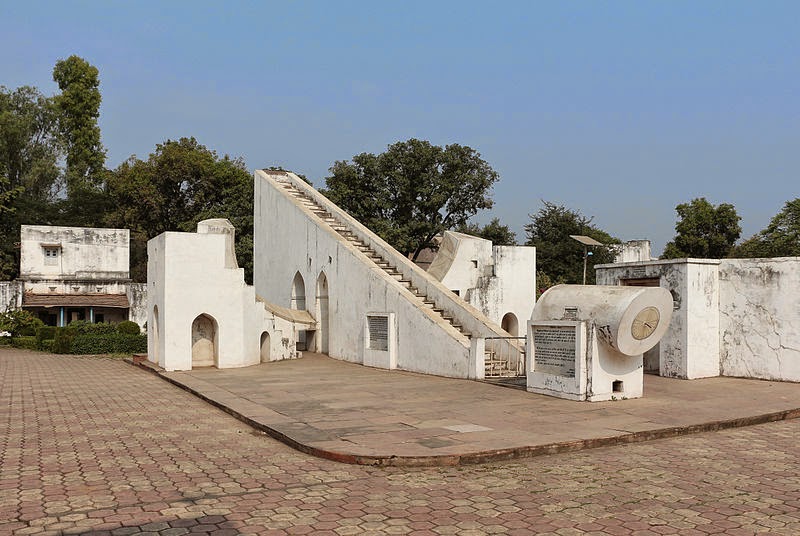
Sun Dial

Sun Dial


The upper planes of the two walls on the sides of the steps in the middle of this instrument are parallel to the axis of the earth. In the direction of the planes the pole star is visible. To the East and the West of the wall the quarter of a circle is formed in the plane of the Celestial equator on which hours, minutes and a third part of a minute are engaged.

When the Sun shines in the sky, the shadow of the edge of the wall falls on some mark indicating local time of Ujjain be calculating the hour and minutes. By adding minutes to this clear time table given on the east and the west side of the instrument, one knows the Indian Standard Time.
This Instrument is mainly used to find out the declination of any celestial body from the celestial equator towards the north or the south. First find out the particular point on the edge of the quadrant from where the centre of the celestial body could be observed to coincide with the edge of the wall. The reading at this point of the wall gives the declination.

Bhartrihari Gufa (caves)

Bhartrihari Gufa (caves)


These caves are situated just above the bank of the Shipra near the temple of Gadkalika. According to tradition, this is the spot where Bhartrihari, who is said to have been the stepbrother of Vikramaditya meditated after renouncing worldly life. He is believed to have been a great scholar.

Nadi Valve Yantra

Nadi Valve Yantra


This instrument made in the plane of the celestial equator has two – the north and the south parts. When the Sun is in the northern hemisphere for six months, the northern hemisphere disc is illuminated. But when the sun is in the southern hemisphere for the remaining six months, the southern disc is illuminated. The exact time of Ujjain is known by the shadow of the nails fixed parallel to the Earthâs axis in between these two parts.
This instrument is used to ascertain whether a celestial body is in the northern or the southern half. Observe a desired planet straight from a suitable point on the round edge of the northern part. If it is visible, then deem it to be in the northern hemisphere, otherwise it is in the southern one, likewise, information could be had from the southern part.

Tuesday, 25 November 2014

Siddhavat Mandir

Siddhavat Mandir

 jai shree mahakal


As there is glory of the Ashayarat in Prayag, Boudhvat in Gaya and Vanshivat in Vrindavan and Panchavata of Nasik just like that Siddhvat is a famous place of pilgrimage in Ujjain. According to tradition, all these trees are immortals & worshipped as Kalpniksha. According to Aramkand of Skandpurana, this tree was planted by Goddess Parvati herself. In diety devil war, the demons emperor Tarkasu was killed by Swami Kartikeya, the son of Lord Shiva. Kartik Swami was appointed as army leader by diety. Under this tree the power by which Swami Kartikeya killed Tarkasu is situated in the middle of Shipra and is known as Shaktibeah Tirth. Thousands of pilgrims take a dip in the Shipra from the bathing ghat built here.

Goddess Parvati made food eaten by Swami Karthikeya. According to history Raja Vikramaditya got Betal Siddhi after doing austerity here. Mahendra, Sangamitra the son & daughter of Raja Ashok after worshipping here traveled long distances – to countries such as Sri Lanka. In the Mughal times, destruction took place in Ujjain like other places in India. At the same time, this tree was cut & closed by 7 round plates but immediately after a great blitz it got free again. It is the characteristic of this pilgrimage that is related with property, children and salvation. 3 main characteristics are-

For the fulfillment of desires the thread (Raksha Sutra) is tied here.
For the desire of child especially an opposite Swastik is made here afterwards the lap is filled by coconut.
For the peace of forefathers (milk is poured to its branches). There is a special importance of Pind Dan here.

The little village of Bhairogarh near Siddhavat was known for dye painting for centuries. In ancient times when trade with other countries flourished, cloth from Bhairogarh found its way to Rome & China.

Insights: I skipped this mandir and we drove towards Mangalnath mandir but wifey Aparna insisted that we return to the place, a wise decision. I was greatly enamored by this open-air temple on the banks of the river Shipra. Something special about the place. To the right of the temple is the Tree where devotees tie red thread. People come from far and wide. We met an old couple from Churu Rajasthan.

Gadhkalika Mandir

Gadhkalika Mandir


 jai shree mahakal


Shri Gadhkalika mandir is traditionally known to be the choice of worship of the greatest poet Kalidasa – the author of Abigyna Shakuntala and chief gem of the court of Raja Vikramaditya. Images and bricks & part of the plinth are of the 1st century B.C. (Shunga period), 4th century A.D. (Gupta period) and 10th century A.D. (Parmar period) were recovered from the basement of the temple. Emperor Harshvardhan got this temple renovated in the 7th century a.d. – there is some indication of its further renovation in the 10th century a.d. under Parma rule. In the 20th century, the traditional priest Shri Siddhanath Maharaj got this temple renovated in Samvat 2001 (1944 A.D.). The temple has been rebuilt in modern times by the erstwhile Gwalior state. A beautiful sculpture of Yakshini belonging to the 4-5th century a.d. was recovered from this place, which is presently displayed at Bharati Kala Bhavan Museum, Ujjain.

Shanku Yantra

Shanku Yantra


A vertical gnomon (Shanku) is fixed at the centre of the circular platform having a horizontal shape. The seven lines drawn according to the shadow of the gnomon indicate the twelve zodiac signs. Among these lines, the 22nd December makes the shortest day, the 21st March and the 23rd September make the days and nights equal, and the 22nd June makes the longest day of the year. With the help of the shadow of the gnomon the angle of elevation and zenith distance of the sun can determined. The Altitude of Ujjain is determined by the mid-day shadow of Shanku Ynatra when the days and nights have equal length.


Kalidasa Academy

Kalidasa Academy .part 1

 jai shree mahakal


This academy was set up in Ujjain by the Government of Madhya Pradesh to immortalize the memory of the great poet dramatist-Kalidasa, and to create a multi-disciplinary institution to project the genius of the entire classical tradition, with Kalidasa as the apex, enable research and study in Sanskrit classical and traditional performing arts, and facilitate its adaptation for contemporary stage in different cultural settings and language groups. The Academy complex consists of a theatre, museum, library, lecture and seminary halls, mini stage for rehearsals, research facilities for scholars, and a large open-air theater.

Quote HCI, “Kalidasa is by common consent the greatest and poet and dramatist that ever in India. Yet curiously enough, we know hardly anything about his life and have no definite knowledge of the time when he flourished. He is said to be one of the nine learned men who graced the court of king Vikramaditya. Most scholars regarded as a historical fact his association with king Vikramaditya of Ujjain, and the deliberate change in the name of the hero of the Vikramorvasiyam from Pururavas to Vikrama lends color to it. Some regard this Vikramaditya as the ruler, who according to well established tradition defeated the Sakas in 58 B.C. and found an era – the well-known Vikrama samvat to commemorate this fact. There are many views on when he existed. The safest course is to hold that Kalidasa

flourished some time between 100 B.C. and 450 A.D.


Monday, 24 November 2014

Vikram Kirti Mandir

Vikram Kirti Mandir


Established on the occasion of the second millennium of the Vikram era, as the cultural centre to perpetuate the memory of Vikramaditya, the Vikram Kirti Mandir houses the Scindia Oriental Research Institute, an archaeological museum, an art gallery and an auditorium. The Scindia Oriental Research Institute has an invaluable collection of 18,000 manuscripts on various subjects and runs a reference library of important oriental publications. Rare manuscripts in Prakrit, Arabic, Persian and other Indian languages cover a wide range of subjects from Vedic literature and philosophy to dance and music. Palm leaf and bark leaf (Bhurja Patra) manuscripts are also preserved in this institute. Apart from an illustrated manuscript of Shrimad Bhagavata in which actual gold and silver have been employed for the paintings, the Institute has a rich collection of old paintings in the Rajput and Mughal style. The museum also exhibits a rich array of images, inscriptions, copper plates and fossils discovered in the Narmada valley. A huge skull of a primitive elephant is of special interest. Unfortunately the Mandir was closed for Christmas holiday when we went there.

Vikram University Crest

Vikram University Crest


The Lions, the Rising Sun (which together form the Crest of the Great Vikramaditya) represents the indomitable courage and rising height of wisdom. The book poised lightly on the petals of the lotus signifies the numerous branches of learning. The silhouette of the Temple of Mahakaleshwar symbolizes the sacred culture of the ancient city of Ujjain the seat of this University. The University was established in 1957.

Vikrama Samvat

Vikrama Samvat

 jai shree mahakal


Unlike the Christian calendar which is based on the birth of Jesus the Vikram Samvat calendar is based on the year from which King Vikramaditya established peace & prosperity over Malwa. HCI have dedicated five pages to Samvat in volume 2. According to HCI, “The era might after all have been founded by a foreigner as stated above. But there is no inherent congruity in the belief that king Vikramaditya founded it in 59 B.C. to commemorate his recovery of Ujjayini by defeating the Sakas”.

Insights: Besides the Vikram University the only icon of Vikramaditya in Ujjain was in a bye lane close to Harsiddhi mandir. The sad part is that there is for the common man not enough information about Vikramditya & Kalidasa

both of whom are synonymous with Ujjain in a historic sense. I tried hard but did not find any City sign boards that spoke about them.

Sunday, 23 November 2014

Chardham Mandir

Chardham Mandir


Founded by Shanti Swarupanandji Maharaj. Since a number of us are unable to do the chardham for a variety of reasons Maharajji made four temples in Ujjain itself so that devotees can take anand (joy) there itself. The char dhams are Jagannath dham (East, Orissa), Dwarkadhish dham (West, Gujarat), Badrinath dham (North, Uttranchal) and Rameshwar dham (South, Tamil Nadu).

Har Siddhi Mandir

Har Siddhi Mandir

 jai shree mahakal


This is one of the prominent temples of Ujjain. The image of goddess Harsiddhi painted with vermilion is located between the images of Mahalaxmi & Mahasaraswati here. Shreeyantra is also located here. According to tradition, this is the real harsiddhi. In tantric tradition, it is regarded as a siddha-peth.

According to Shiv puran, when Lord Shiva was taking the great Sati from the yagna of dakshya Prajapati, the elbow of Sati fell in this place. According to Skand puran, the goddess was called Harsiddhi for killing two demons o Chanda & Prachand. According to folk tradition, harsiddhi is the worshipping goddess of Raja Vikramaditya.

There is a mention of this temple in the books of the 13th century A.D. but present temple is of the Maratha period. An artistic pillar adorns the entrance. The two large columns situated in the courtyard of the temple are Deepswthambs or lamps, symbols of Maratha architecture. Lit during Navaratri they present a glorious spectacle. On one of the columns of the present tank, the year 1447 is subscribed. There are few other temples of gods and goddess on the premises. The Karkoteshwar Mahadev mandir, one of the main temples out of the 84 mahadev is situated in the temple premises. In both the narratives occasions, special worship & celebration are performed here in the month of Chaitra & Ashwin. It is believed that the Goddess of this temple Mataji remains at Koila Dungar temple in Porbander for twelve hours and comes to Ujjain ka temple in the evening during aarti time.

Insights: There is something special about this temple complex. We found the environs very peaceful and rejuvenating. There was some stirring within.

Sandipani Ashram

Sandipani Ashram

 jai shree mahakal


The fact that ancient Ujjain apart from its political and religious importance, enjoyed the reputation of being a great seat of learning as early as the Mahabharata period is borne out by the fact that, Lord Krishna and Sudama received regular instruction in the ashram of Guru Sandipani. The area near the ashram is known as Ankapata, popularly believed to have been the place used by Lord Krishna for washing his writing tablet. The numerals 1 to 100 found on a stone are believed to have been engraved by Guru Sandipani.

According to Puranic tradition Krishna & his friend Sudama received regular instructions in the Ashram of Kulaguru Sandipani. Besides Mahabharata, the Puranas, Shrimad Bhagavata, Brahma, Agni & Brahmavairaita bear references to the Sandipani Ashram. Archaeological evidence of 3,000 years old painted grey wares has been recovered from this area. These bear a resemblance to the similar remains recovered at Hastinapura, Indraprastha, Mathura & Kausambi. These evidences show that this region is the oldest in the city. Gomati Kund is the old source of water supply to the Ashram & the same has been referred to in the Puranas also.

The image of standing Nandi near the tank is worth seeing and it belongs to the Shunga period. We were told that it is the only temple in India where Nandi is standing as elsewhere Nandi is found sitting. The area nearby is known as Ankapata.

In all Shiv temples the Nag (snake) is invariably wound around the Lingam. In this ashram there is a Shiv temple in which there is a lingam with the Nag crawling by its side.

In the beginning of the 16th century the great Vaishnava saint Shri Vallabhacharya delivered his religious discourses in the vicinity of this ashram. The followers of the Vallabha sect count this place as the 73rd seat of their acharya who is said to have made 84 sittings for religious discourses throughout through out India. We were taken around by Harsh Vyas who belongs to Sandipani Rishi ka vansh.

Insights: Mitras something special about this place, the positive vibrations and feeling of equanimity that we experienced.

Mangalnath Mandir

Mangalnath Mandir


 jai shree mahakal


According to Matsya puran, this is the birthplace of Mangalgraha or Mars. Flowing Shipra river presents a very beautiful view in front of the temple. Devotees gather in large numbers esp. on Tuesday. Located on a hillock, this place represents the highest place in the area. In ancient times, the place was famous as it is said to have provided a clear view of Mars – Ujjain was an important center for astronomical studies. This place, traditionally known for its suitability for astronomical readings of mars continues to hold its religious importance. Worship of Lord Shiva is offered at the temple. Karkarekha goes through the center of the Shivalinga at Mangalnath, it is centrally placed.

Insights: This is the only authentic temple in the country for the puja of the Mangal graha which is Mars. As a planet Mars is supposed to make a person very aggressive which could have adverse effects overall if the energy is not channelised in the right manner. For those who have mangaldosh a special puja is performed only at this temple in the country. We witnessed one such Shanti Puja in which the lingam was smeared with kumkum, panchaamrut and later on with cooked rice. Finally the Pandit completed the puja with Shringar of the lingam. We were fortunate to witness the entire process. Even though it was someone else’s puja he explained the entire process to us and got us to experience it firsthand.

Kaal Bhairav

Kaal Bhairav


 jai shree mahakal


Shaivite form of worship has also assigned importance to the adoration of 8 Bhairavas. Kaal Bhairav is the foremost amongst them. Skanda purana has made a mention of the temple of Kaalbhairav in its Avanti Khanda. According to some antique tradition, the followers of Kapalika & Aghora sects used to worship Shiva or Bhairava. Ujjain was also connected with the pattern of worship developed by these sects. People offer liquor as part of the worship. It is said that a certain king named Bhadrasen got this temple constructed; this must have been a great temple during the Parmar period. Images of Shiva, Parvati, Vishnu & Ganesh have been recovered from this place. This temple was rebuilt with the remains of the old temple. Beautiful paintings in Malwa style once decorated the temple walls. The temple to the right of the courtyard is dedicated to Vithala and to the left is a Dharamshala.

Insights: Seeing devotees offer liquor to God can be scary for some not for those who come with bhavna & respect for the Lord. The mandir is situated on what was once a cremation ground. A new cremation ground is situated close to the mandir. The temple Pandit looked a bit different, wifey found him scary but I found him very intuitive.

Shani Mandir

Shani Mandir


Triveni Navagraha: the temple of Navagraha, the nine planets situated on the Triveni ghat of Shipra is a prominent center of attraction for piligrims. The temple is about 150 years old. Large crowds come to the Navagraha temple on the Amavasya falling on Saturdays. Religious importance of this place is increasing in recent times although there is hardly any reference to this in ancient texts. Mythological sanctity of the invisible river Saraswati is associated with the story of Triveni Sangam.

Chintamani Ganesh Mandir

Chintamani Ganesh Mandir

 jai shree mahakal


The present sanctum of Chintamani Ganesh is very old. The Ganesh icon is swayambhu – born of itself. Riddhi & Siddhi, the two goddesses are enshrined on both sides of the icon of Ganesh. Traditionally, this is known as the seat of Chintaharan Ganesh (assurer of freedom from worldly anxieties). People assemble here in large numbers to offer their prayers on Wednesdays in the month of Chaitra. Artistic pillars in the assembly hall of the temple belong to the Parmar period (9-12th century). The temple was renovated by Ahilyabhai Holkar with the addition of a water tank and boundary wall. It is said that while returning to Ayodhya after victory over Ravana, Lord Ram rested here. To get rid of thirst, Lakshman dug out the water with his arrow. This is the reason the water tank is called Banganga.


 jai shree mahakal


Saturday, 22 November 2014

Jantar mantar

Jantar mantar


Vedh Shala, Ujjain is India's first observatory . The city of Ujjain is considered the Greenwich of India due to the fact that the first meridian of longitude passes through it. Going by the Indian astronomers, the Tropic of Cancer passes through Ujjain. This observatory was constructed by Savai Raja Jaysingh between 1725 and 1730. Similar observatories were constructed by Maharaja Jai Singh at four other places- Delhi, Jaipur, Mathura and Varanasi.

Samrat yantra, Nadivalaya yantra, Digamsha yantra and Yamyottara-Bhitti yantra are the main instruments constructed in this observatory. Motions and orbits of the planets are studied through these instruments. On the account of this people call it Yantra Mahal as well.This observatory was renovated by Madhav Rao Scindia, then Maharaja of Gwalior state in 1923. Astronomical studies of planetary motions are still conducted in this observatory under the department of education and an Ephemeris (Panchang) is published every year.

In other words, this is the only observatory among the observatories of Maharaja Jai Singh where these masonic instruments are even today utilised for astronomical studies.
Vedh Shala, Ujjain possesses instruments that are used to determine the locations of heavenly bodies for astrological purposes. The other things available in Vedh Shala in Ujjain in India are a small planetarium and a telescope for the purpose of moon-gazing and observing the planets Mars and Jupiter and their satellites. The Vedh Shala in Ujjain in India is a bit smaller than those in Jaipur and Delhi but is quite interesting and very much in use.
The structure of the monument reflects the hard word and superb skill that has gone into making it. Maharaja Jai Singh set up new instruments in these observatories employing his skills. He made alterations in a number of main Astro-mahematical instruments by observing the activities of planets himself for eight years in Ujjain. Thereafter the observatory remained uncared for two decades. Then as per suggestions of Siddhntavagish (Late) Shri Narayanji Vyas, Ganak Churamani and Shri G.S. Apte, the first Superintendent of observatory, Maharaja Madhav Rao Scindia renovated the observatory and funded it for active use.

Friday, 21 November 2014

Kaliadeh Palace

Kaliadeh Palace


Situated on an island in the river Kshipra, Kaliadeh Palace was built in the year 1458 AD by the Sultans of Mandu. The palace was demolished at the time of the Pindaris and was restored to its former glory by Madhav Rao Scindia in 1920.

The central hall, which is surrounded with galleries, presents a classic example of Persian architecture. Though lost in the loneliness of the torrents of Shipra River, even now, this water palace holds some religious significance. People from the nearby villages took a dip in one of the tanks, which is called as Surya Kund.
Once a hall of fame, this majestic monument holds two Persian inscriptions, which states about the visit of Akbar and Jahangir. The splendid landscape of the curving river on both sides of the Kalideh palace and the man-made tanks and channels, with water murmuring through them, offers a stunning background to the imposing building.
The Kaliadeh Palace is located on the banks of the River Shipra and is the most visited sites of the state of Madhya Pradesh. It is like an isle that is separated by a small stretch of water that makes it look more elegant. This island-like site immediately conjures up the natural beauty of ancient Ujjain which poets down the ages have waxed lyrical. The glorious landscape of the flowing river on both sides of the palace and the man-made tanks and channels, with water gurgling through them, provide a spectacular backdrop to the imposing building.
Kaliadeh palace, as it is lost now in the symphonious solitude of the streams of Shipra, flowing through tanks and channels with frolicsome twists and turns in the serene setting of nature, was once a majestic Sun-temple. Avanti-mahatmya of the Skanda Purana has recorded a description of the Sun-temple, the Surya-kunda and Brahma-kunda. People from nearby villages have their religious bath in one of the tanks known as Surya-kund even today.
Remains of the old temple are seen scattered here and there throughout the area. The flow of Shipra is divided into two parts on the southern side. The stream of Shipra has been made to rush through tanks and channels carved on the western side by arresting it on the eastern side with a barrage. Kaliyadeh palace was shaped in the present form in the 16th century by Nasiruddin Khilji, the sultan of Malwa.
The central dome of the palace is a beautiful example of Persian architecture. Visits of Akbar and Jehangir to this palace are recorded in two Persian inscription found in the long corridor adjacent to the tanks. The palace came under the control of the Scindias during the Maratha period. The Sun-temple has now been restored here by Rajmata Scindia.


Thursday, 20 November 2014

Simhastha

Simhastha


It finds mention in the Hindu mythological tale of churning of the cosmic ocean by the gods and the demons, with Vasuki, the serpent as the rope. It is believed that the ocean bed first yielded fourteen gems, then Lakshmi, the goddess of wealth, and finally the coveted vessel of Nectar.
In the wild scramble for immortality, with the demons chasing the Gods across the skies, a few drops of the Nectar spilt from the vessel and fell at Haridwar, Nasik, Prayag, and Ujjaini or the present Ujjain. Therefore, the Kumbha Parva is celebrated at the interval of every twelve years at these places.


The specific features of Kumbha alias Simhastha in Ujjain is its association with Leo, thus being famous as the Simhastha Parva. On this occasion the following ten coincidences assemble together
  • The month of Baisakha
  • The bright fortnight
  • The full Moon day (Purnima)
  • The Sun in the arise (Mesha Rasi)
  • The Brihaspati (Jupiter) in Leo
  • The Moon in the Libra (Tula rasi)
  • The vyatipata yoga
  • The pious Monday
  • The holy Ksetra Avantika

On the occasion of this pious Parva lakhs of pilgrims from India and abroad take bath here and exhibit their religious faith. The most peculiar feature is the procession of the seers and sages moving towards the Sipra for the holy dip. These religious leaders stay in Ujjain during the whole Simhastha period and take bath on specific bath-days with freat faith and enthusiasm with their sectorial banners (Nisanas).
During the Simhastha Parva every pilgrim after taking the bath visits the temple and humbly bows down before the Lord. The sight of the temple is very enchanting and rarely seen on that occasion. The law and order situations are well-planned and very alert then. The whole atmosphere echoes with the Jaya Jayakara (Victory to the Lord) Mahakalesvara.